

 en
 zh
 it
 es
 ja
 sv
 no
 nl
 ko
 fi
 ru
 fr
 de
 Oct 21, 2026
On July 22, 2026, a new research achievement by Professor Yaowen Li (SunFlex Chief Scientist and Dean of the Soochow University–SunFlex Photovoltaic Innovation Research Institute, Soochow University), Professor Xiankai Chen (Soochow University), and Professor Tiankai Zhang (Southeast University) was published in the international top journal Nature. The study overcomes a core challenge constraining the industrialization of perovskite solar cells, providing an entirely new technical pathway for developing high-efficiency, ultra-stable, and scalable perovskite devices.
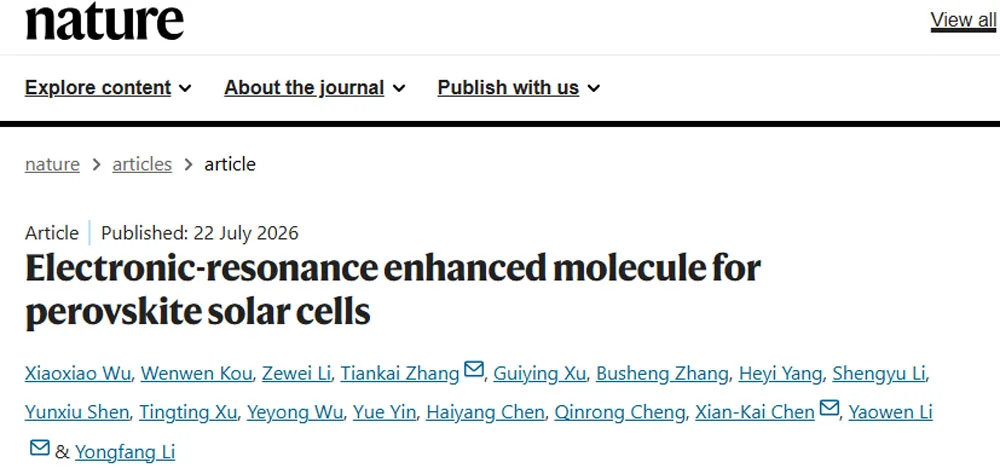
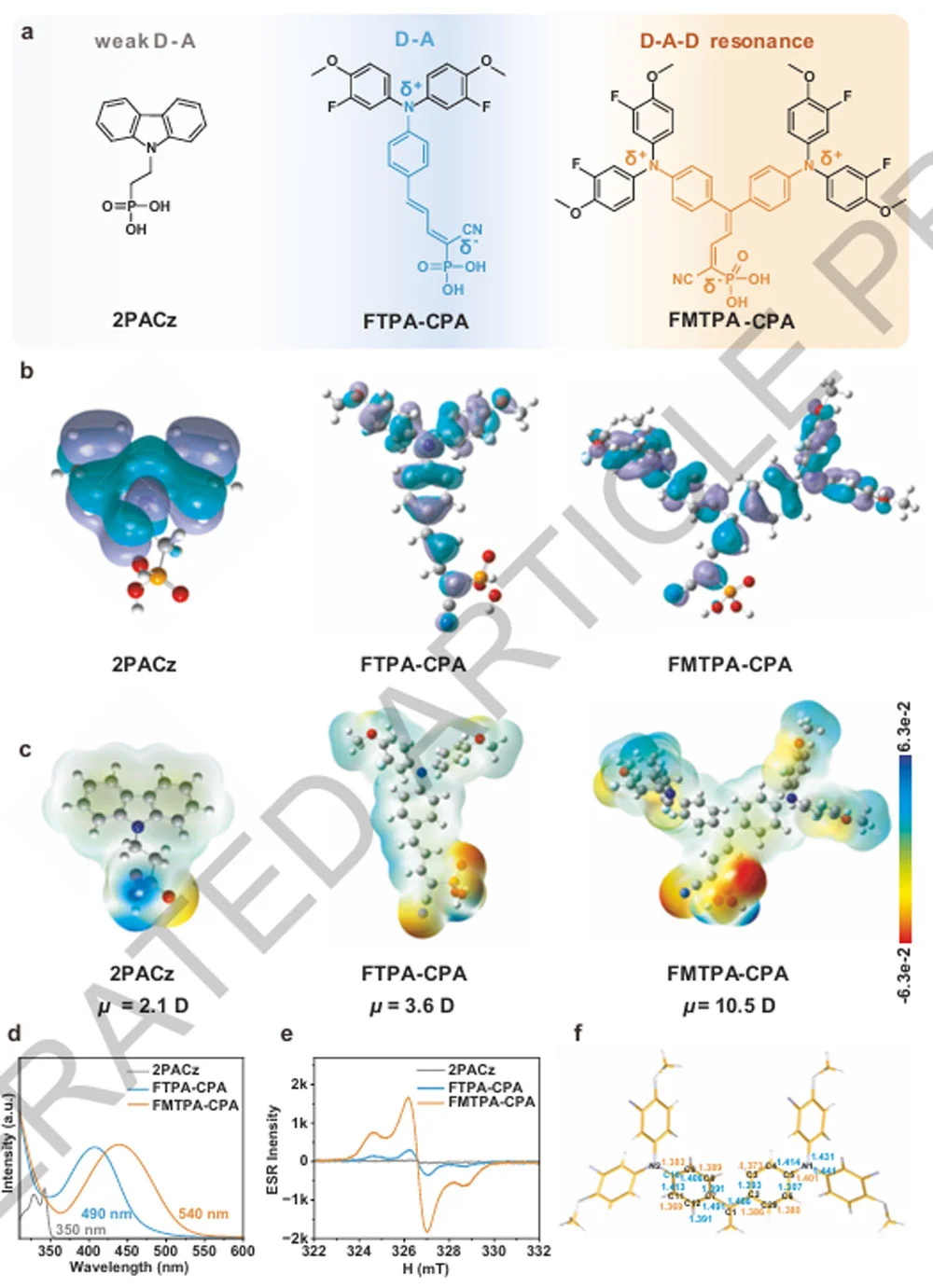
For a long time, the self-assembled monolayer (SAM) has been a key technology for improving perovskite cell efficiency. However, conventional molecules suffer from insufficient anchoring strength and are highly prone to desorption under high temperature, illumination, and thermal-cycling conditions. This leads to degraded carrier-extraction capability and a sharp decline in stability, making it a common technical bottleneck across the industry.
To address this pain point, the team innovatively designed a D-A-D electron-resonance molecular structure (FMTPA-CPA). By leveraging intramolecular electron-resonance effects to increase the electron density of the anchoring group, it significantly strengthens the covalent bonding between the phosphonic acid group and the ITO substrate, fundamentally solving the SAM desorption problem. At the same time, the electron-delocalization effect optimizes interfacial charge transport and reduces non-radiative recombination, achieving breakthroughs on both efficiency and stability fronts.
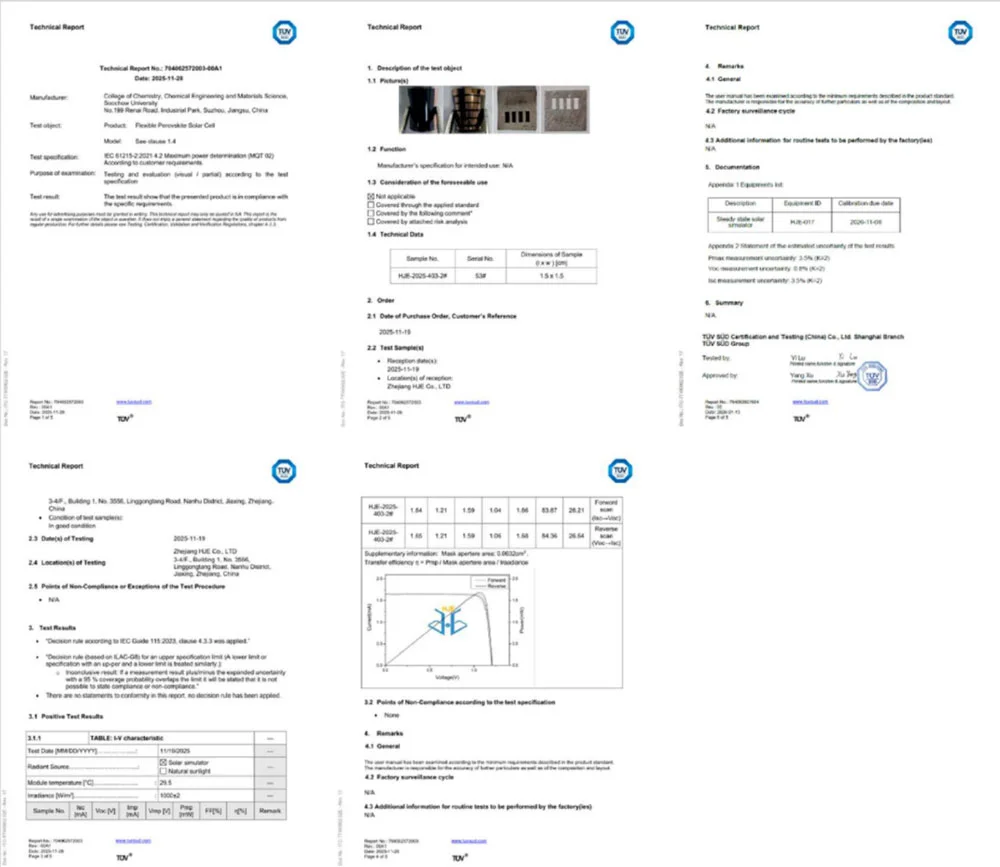
Certified by an independent third-party authority, the technology delivered a certified efficiency of 27.69% for rigid small-area devices, up to 26.64% for flexible devices, and broke 23.63% for a 15.64 cm² large-area module. In rigorous stability tests, the devices retained over 93% of their initial efficiency after 1,080 hours of high-temperature illumination, and over 98% after 720 extreme thermal cycles from −40 °C to 85 °C — demonstrating exceptional environmental adaptability.
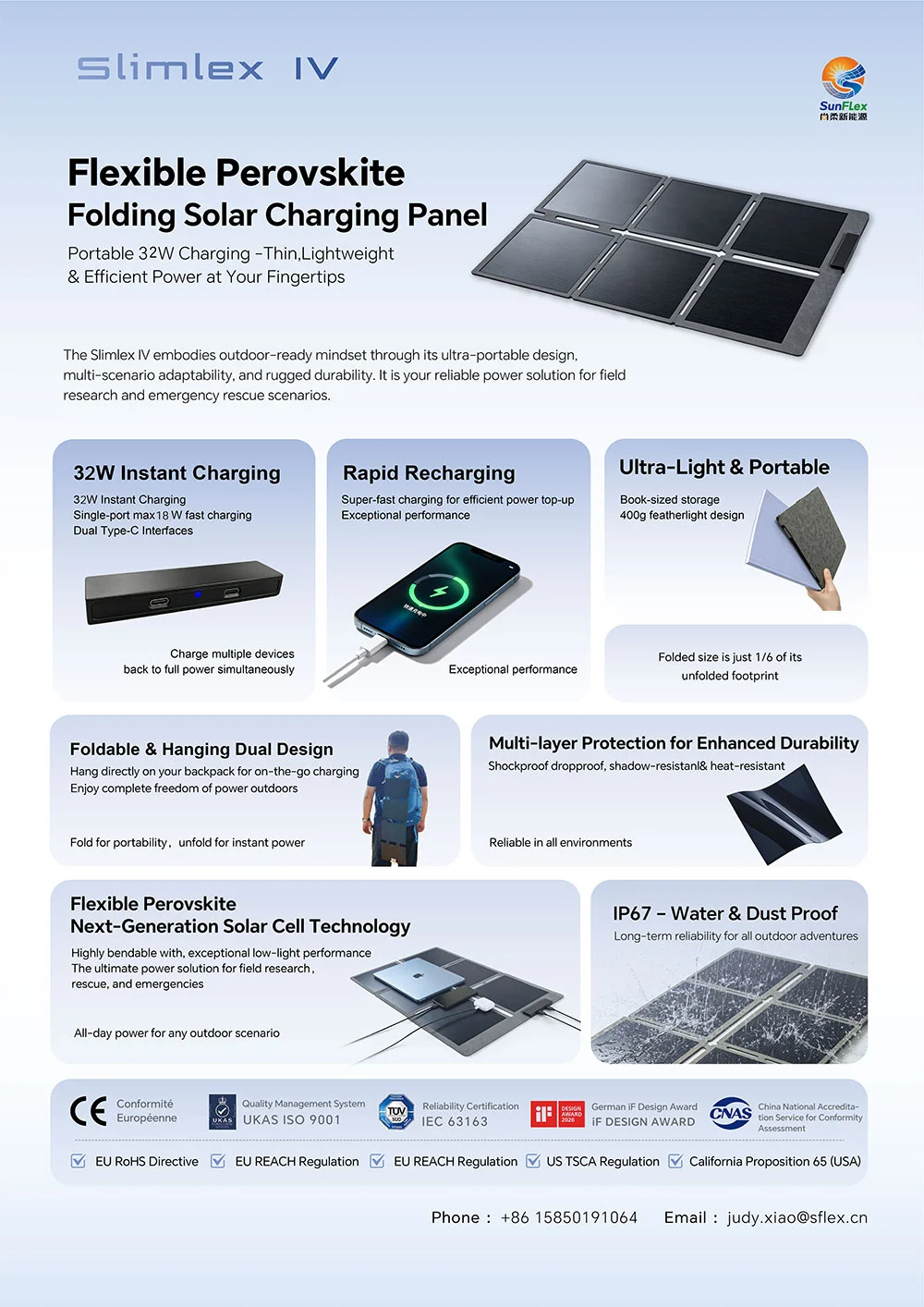
This achievement holds enormous potential for industrial translation. SunFlex has already established a presence across multiple tracks, including consumer electronics, outdoor equipment, smart home devices, and space photovoltaics. The resonance-type SAM molecular system developed in this study is compatible with both rigid and flexible substrates, improving long-term operational stability of devices and resolving the pain point of rapid cell degradation under complex conditions such as outdoor temperature swings and UV irradiation — providing core technical support for the performance upgrade of various products.
This top-journal breakthrough further confirms SunFlex's research strength. Previously, a team led by the company's founder, Academician Yongfang Li, had already published original results in Nature. Two top international journal papers in quick succession fully demonstrate SunFlex's top-tier, stable, and sustained original R&D capability in the flexible perovskite arena.
Long-term commitment to source innovation and tackling underlying technologies is SunFlex's unique core competitive advantage. The company has now independently mastered key technologies in the flexible perovskite field — such as molecular design and interface regulation — and possesses a rare, sustained capacity for original innovation, building technical barriers that are difficult to replicate in the industry. Moving forward, SunFlex will leverage the industry-academia-research platform of the Soochow University–SunFlex Photovoltaic Innovation Research Institute to continuously advance pilot-scale iteration and process optimization of new technologies, accelerate the industrialization of frontier research results, and sustain its leadership in the high-quality commercialization of flexible perovskite.
Original article: https://doi.org/10.1038/s41586-026-10919-4

