
 en
 zh
 it
 es
 ja
 sv
 no
 nl
 ko
 fi
 ru
 fr
 de
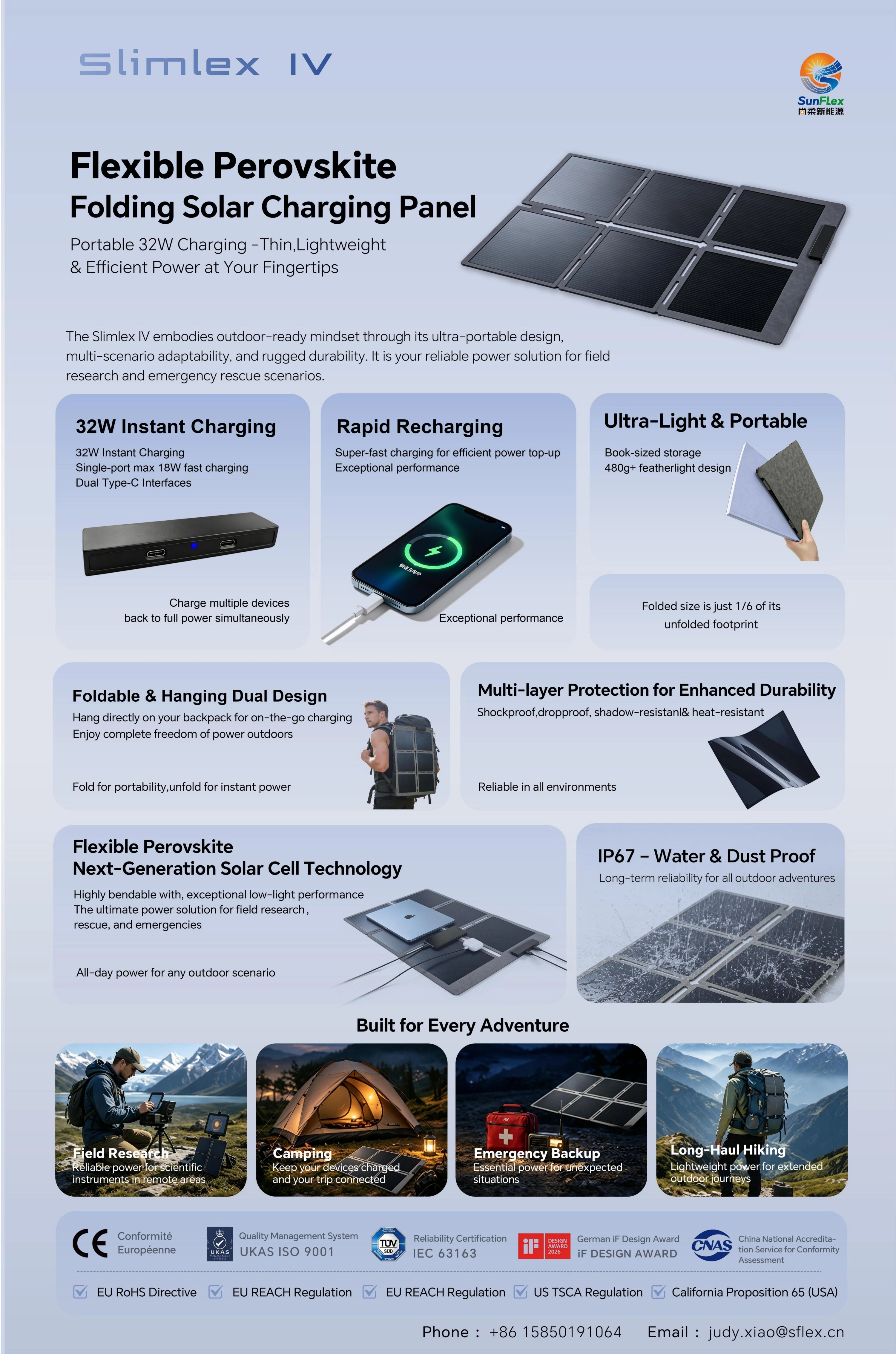
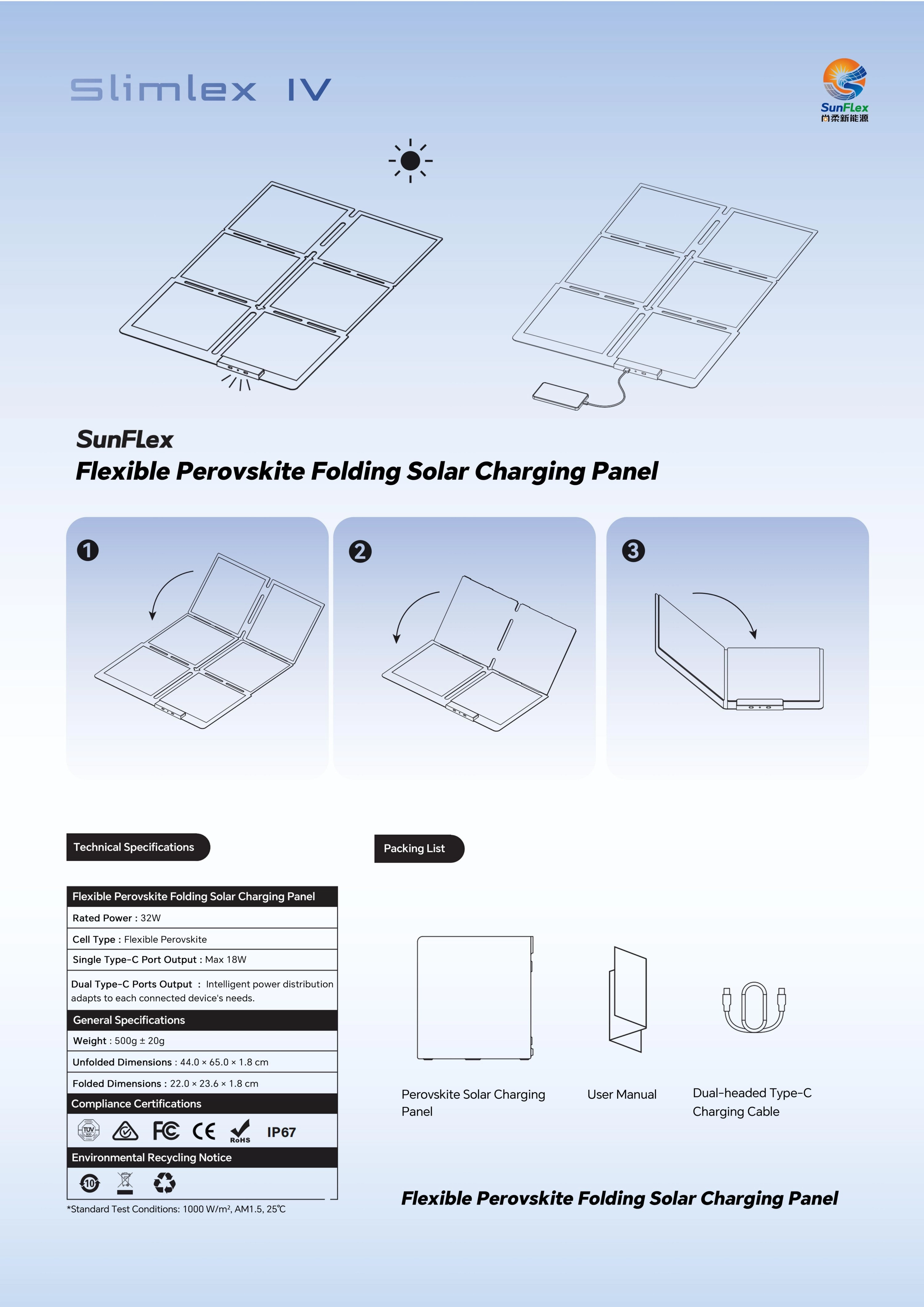
Flexible Perovskite Folding Solar Charging Panel
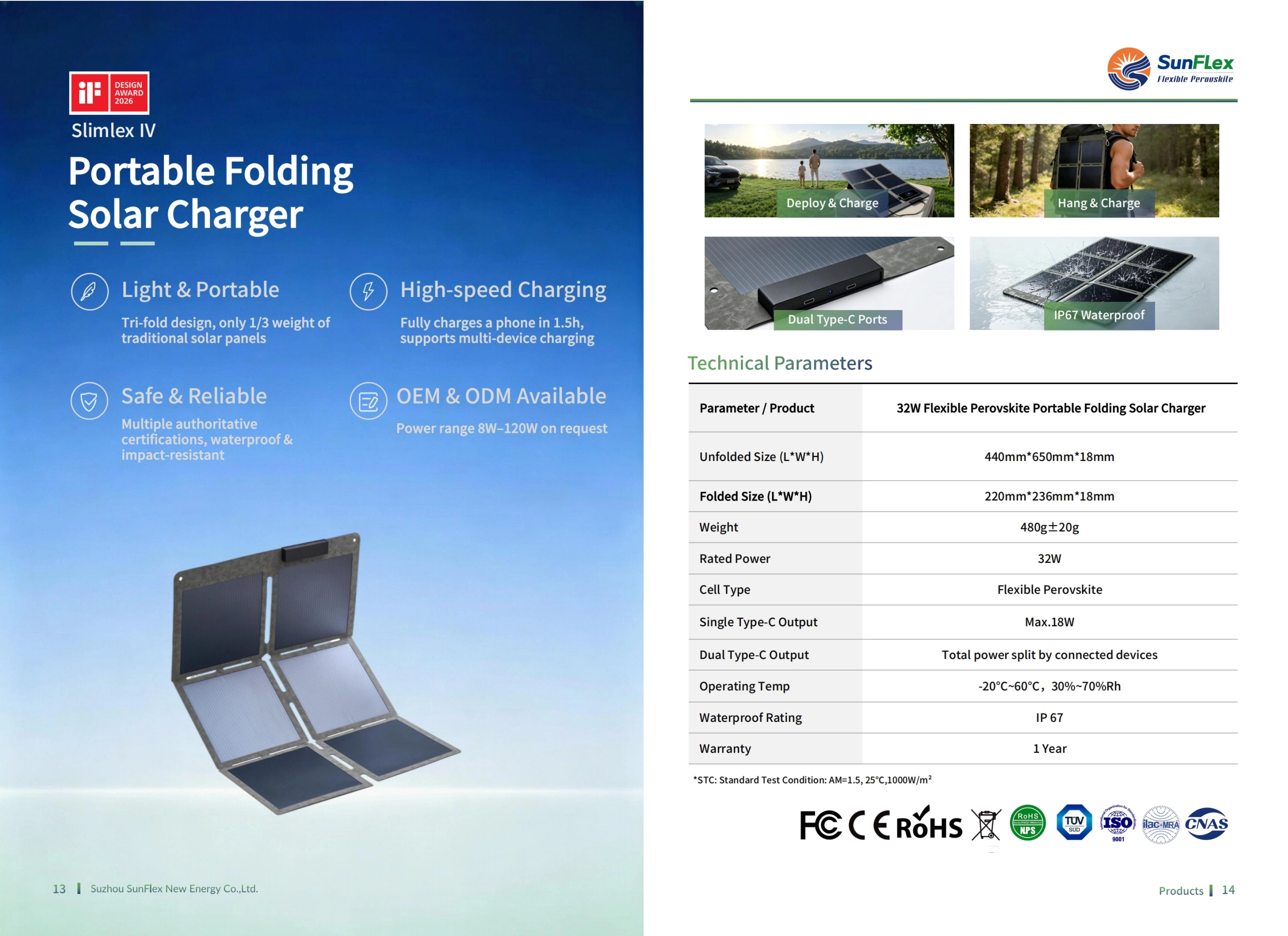
32W
Chat Now
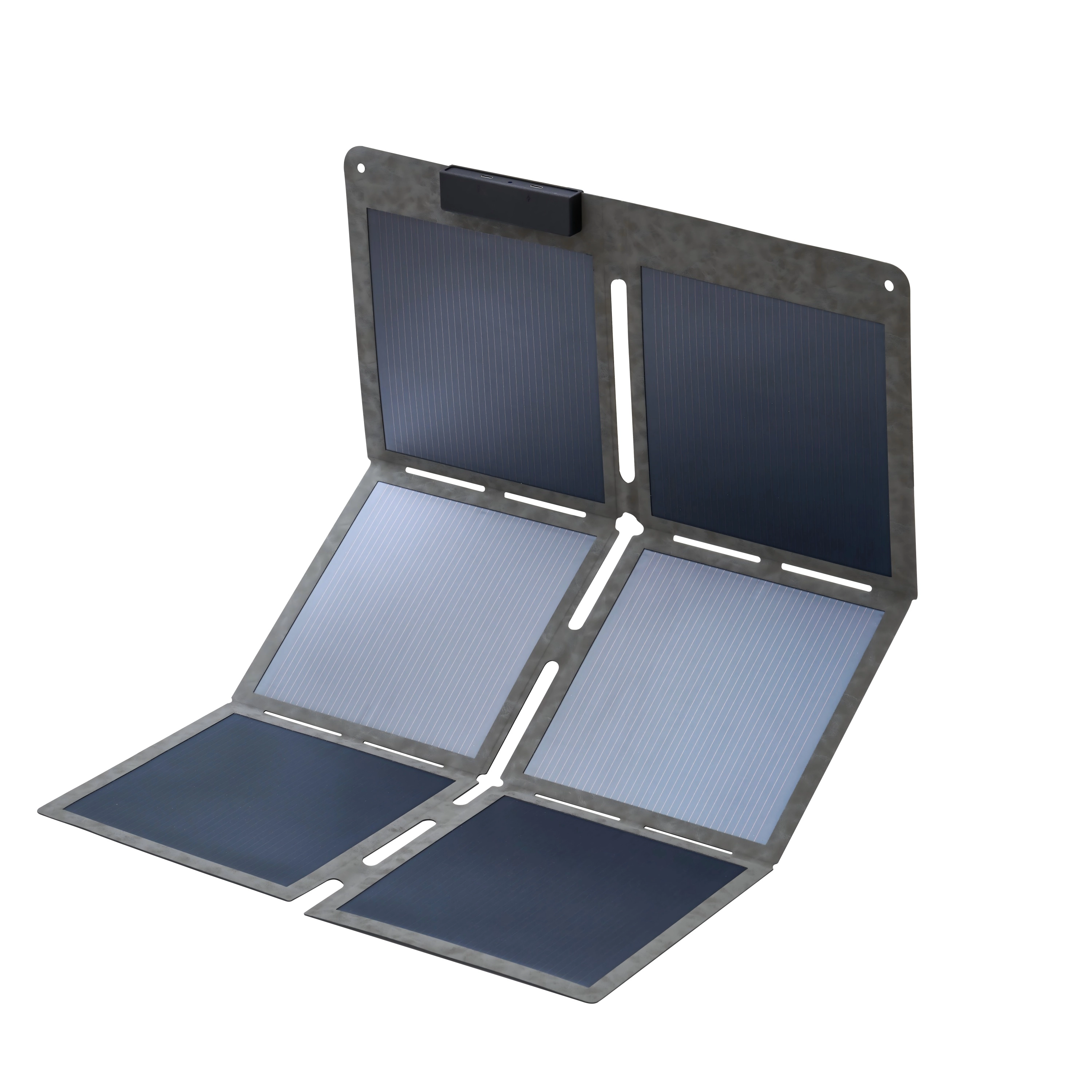
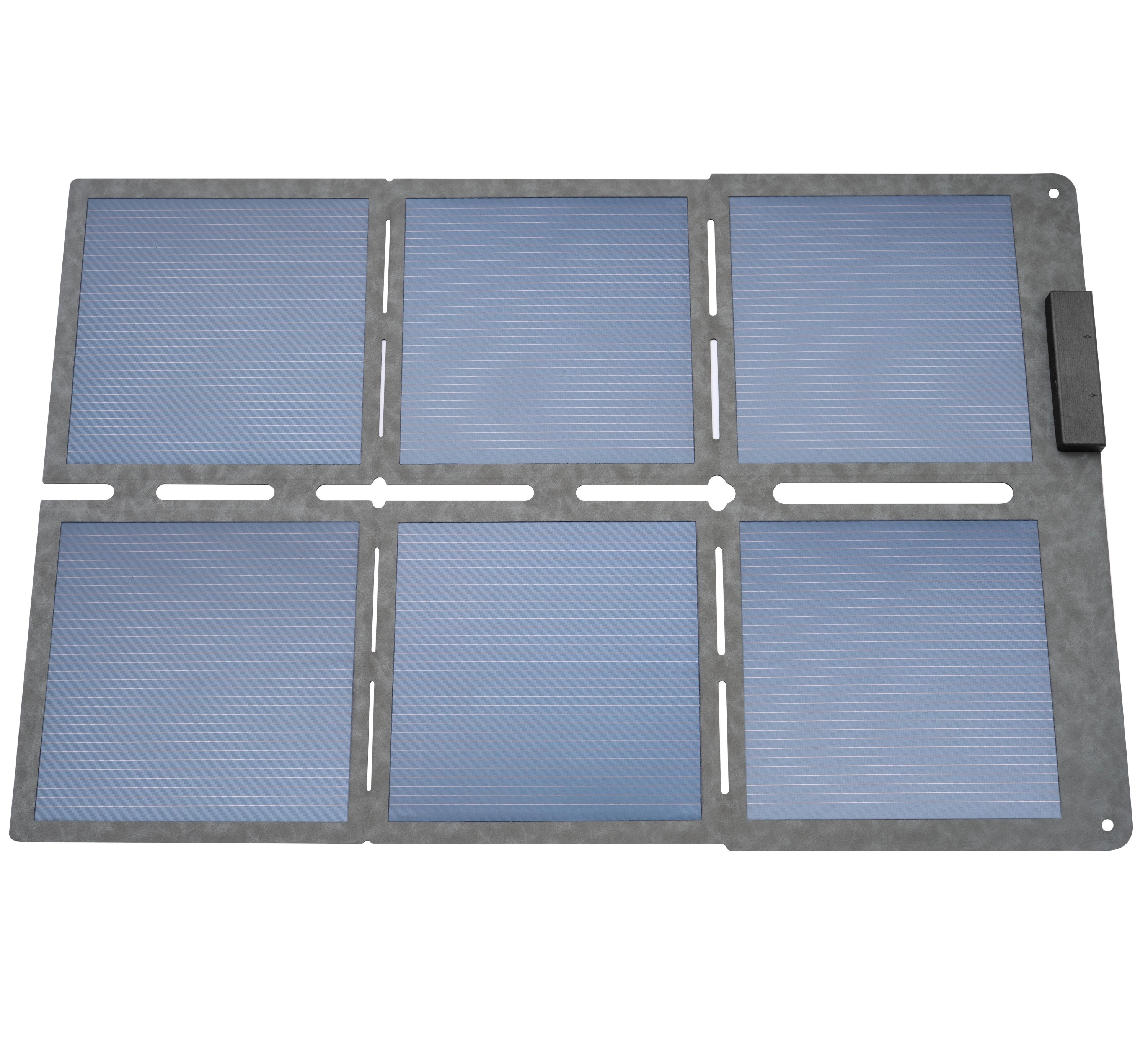
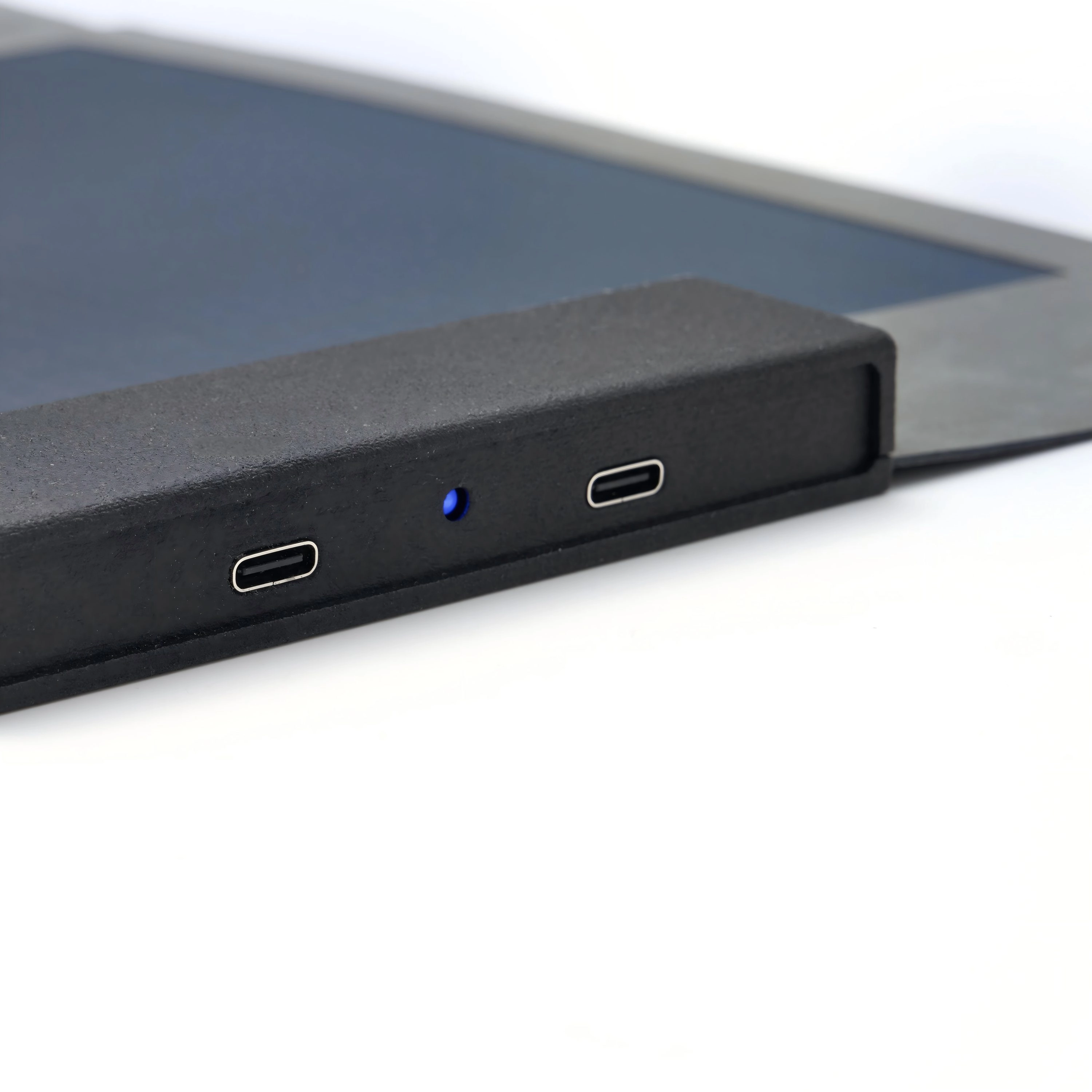

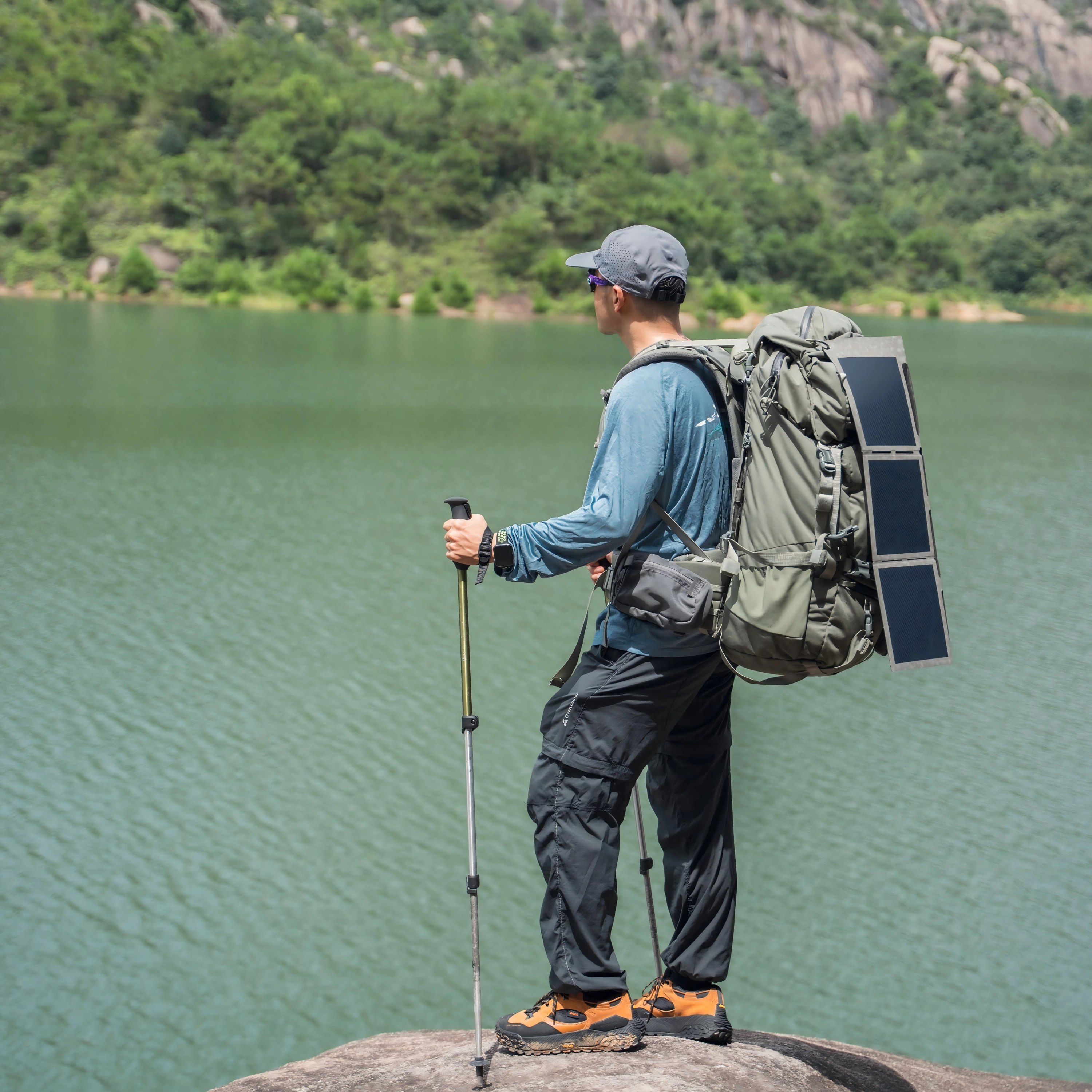
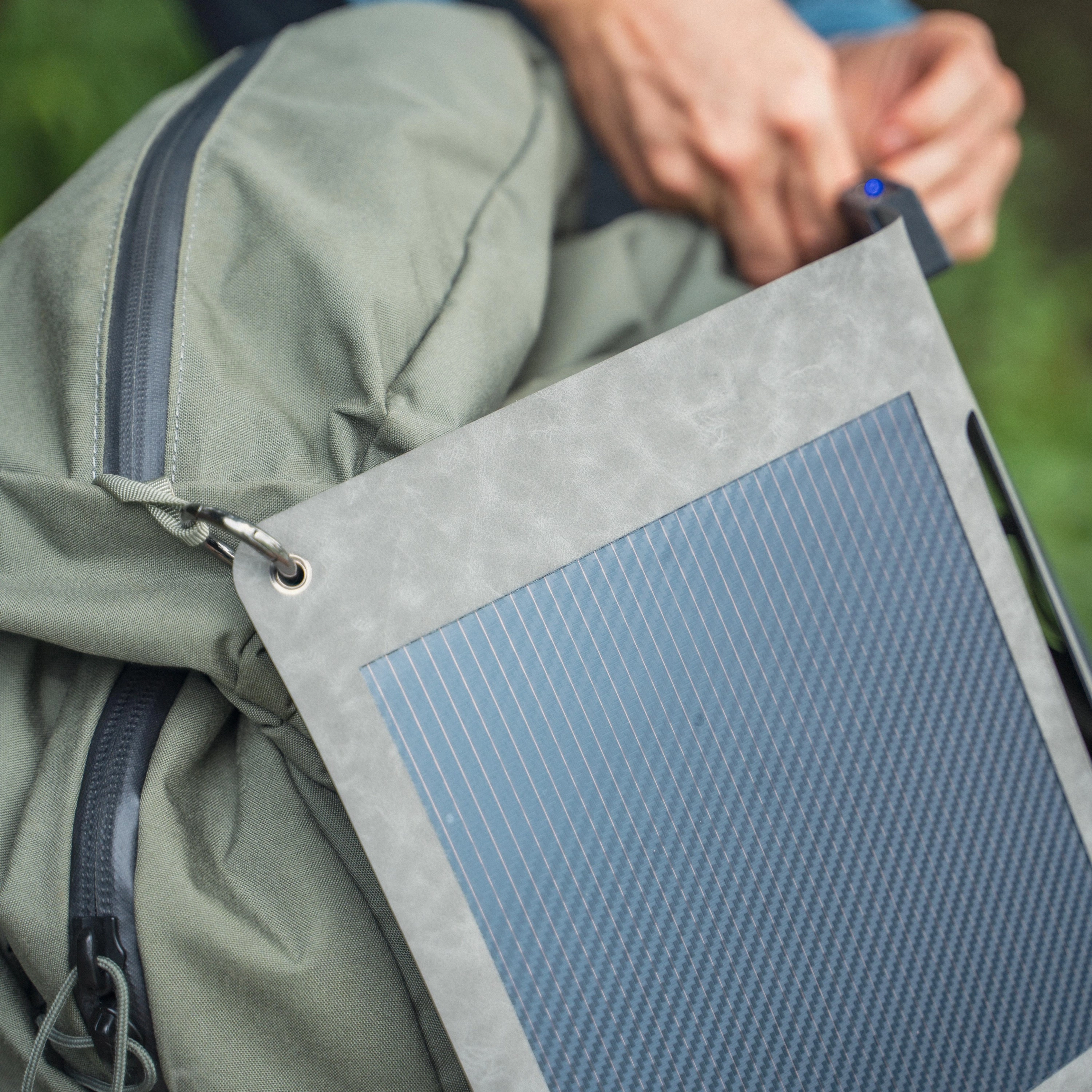

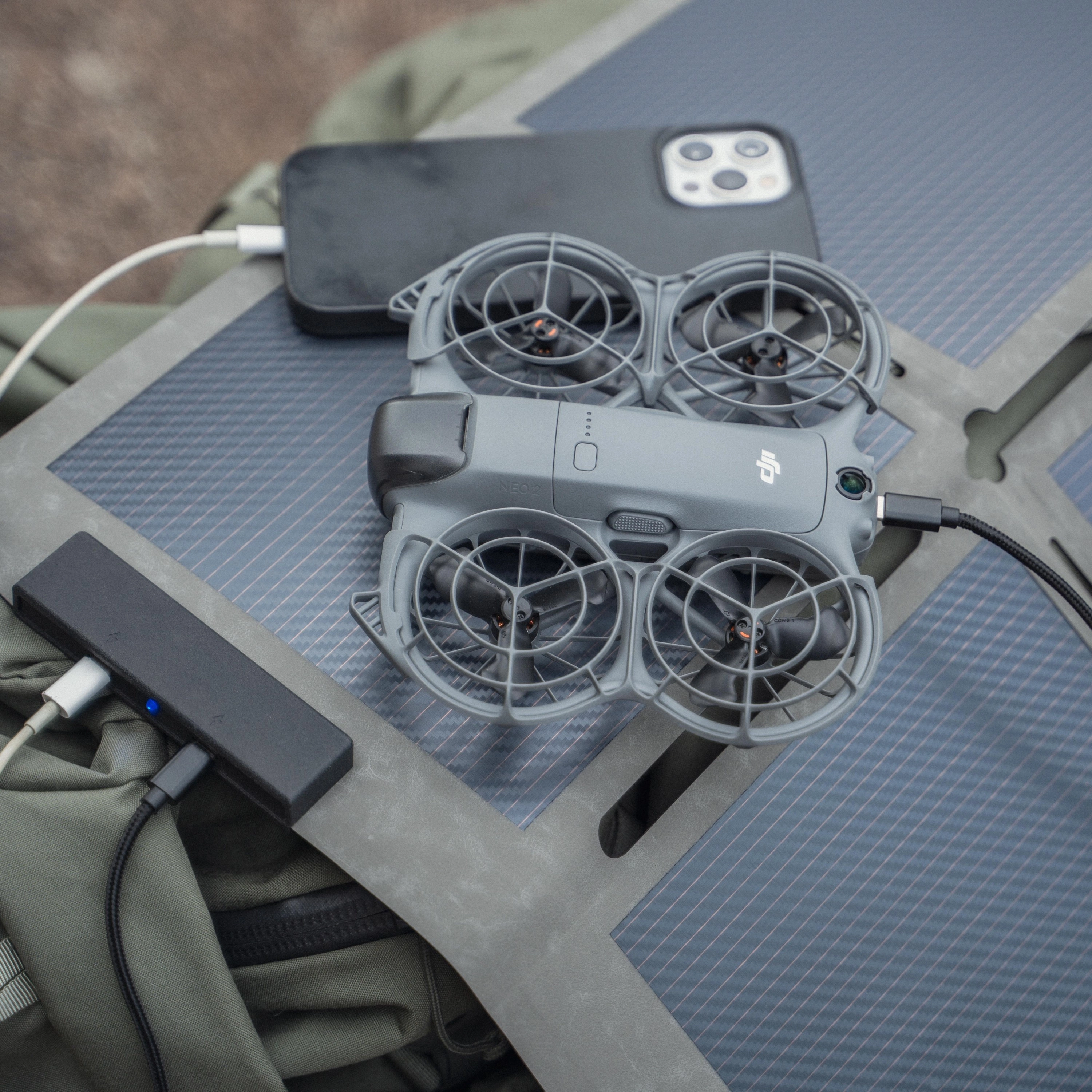
• Custom Power from 8W to 120W, Size on Request
• Full OEM/ODM: Interfaces, Branding & Packaging
• Weak-Light Charging With Flexible Perovskite
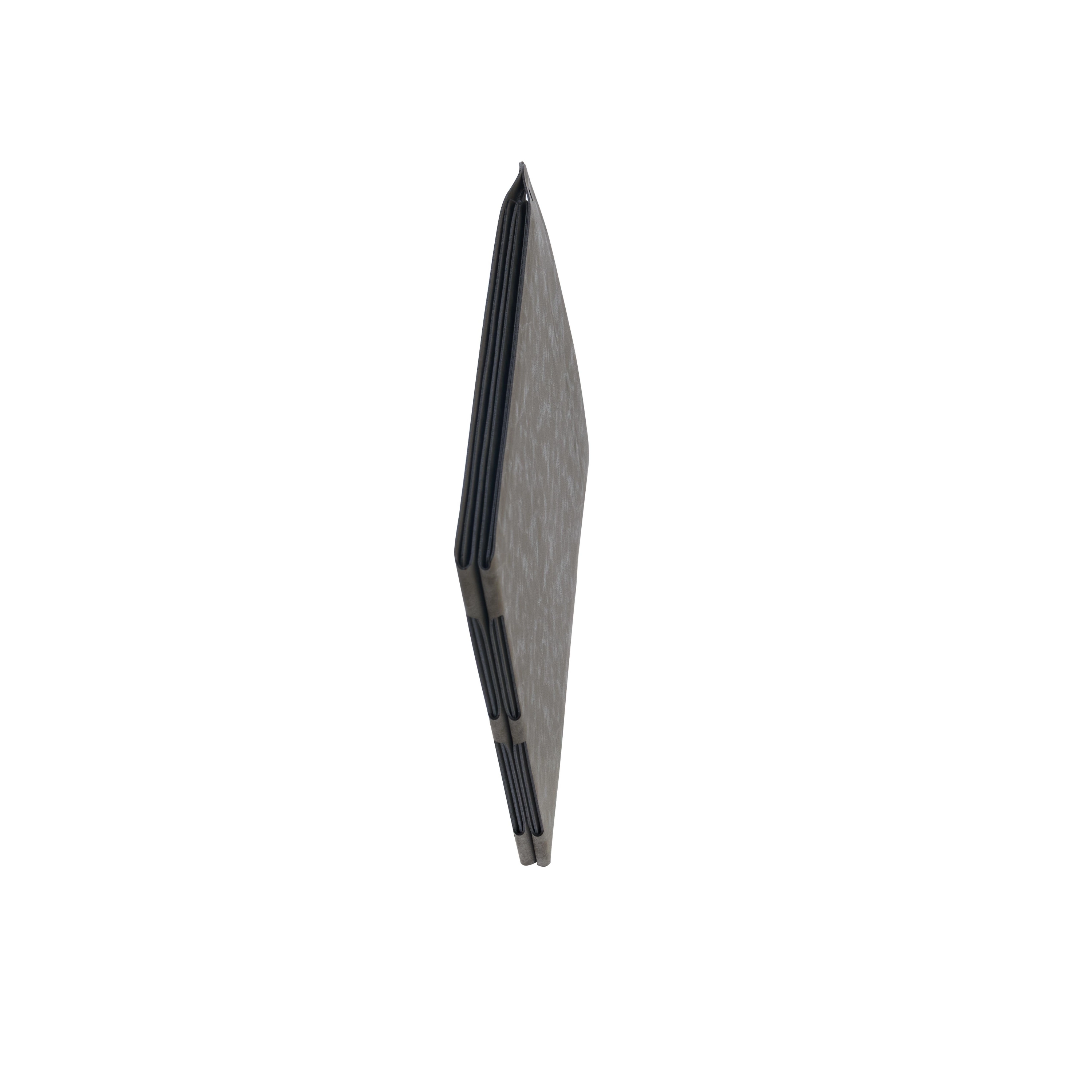
• Featherlight Folding Design, Hang & Go
• Built for Outdoor, Research & Emergency Channels
• Certified for Global Distribution, Award-Winning Design
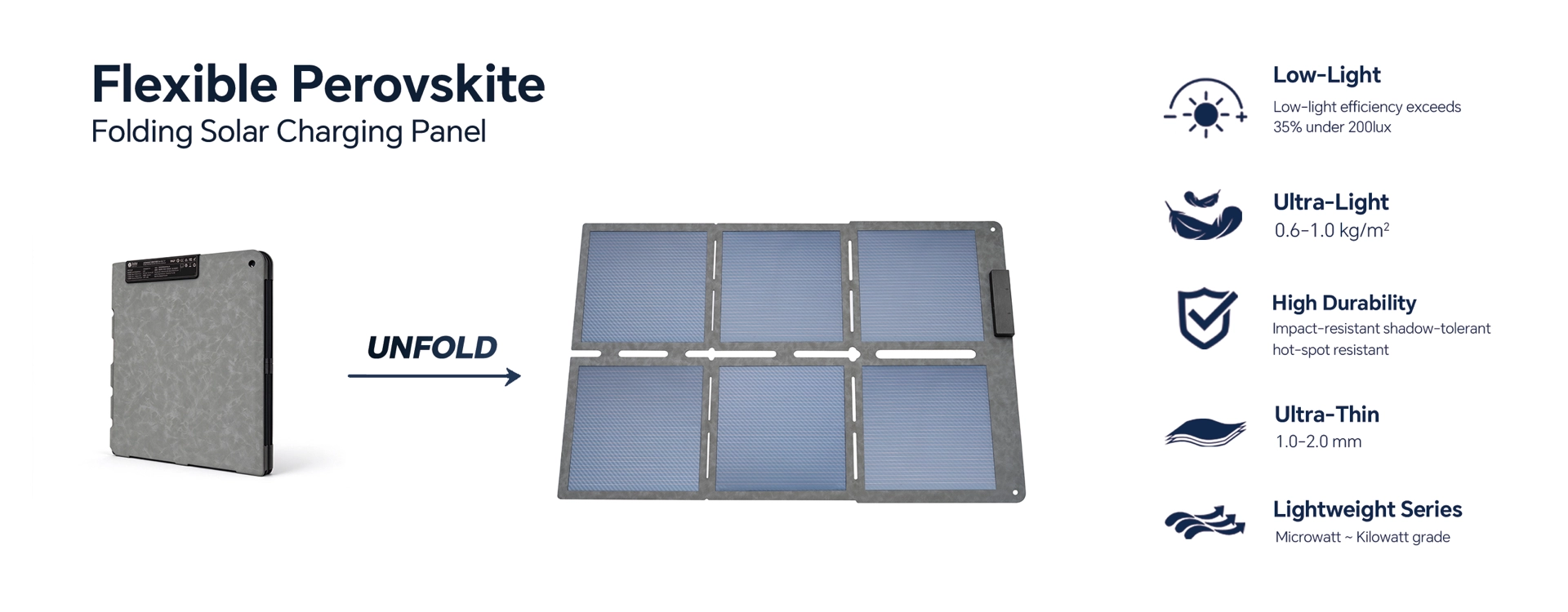
Microwatt to kilowatt — 0.6–1.0 kg/m², 1.0–2.0 mm thin, still working at 200 lux.
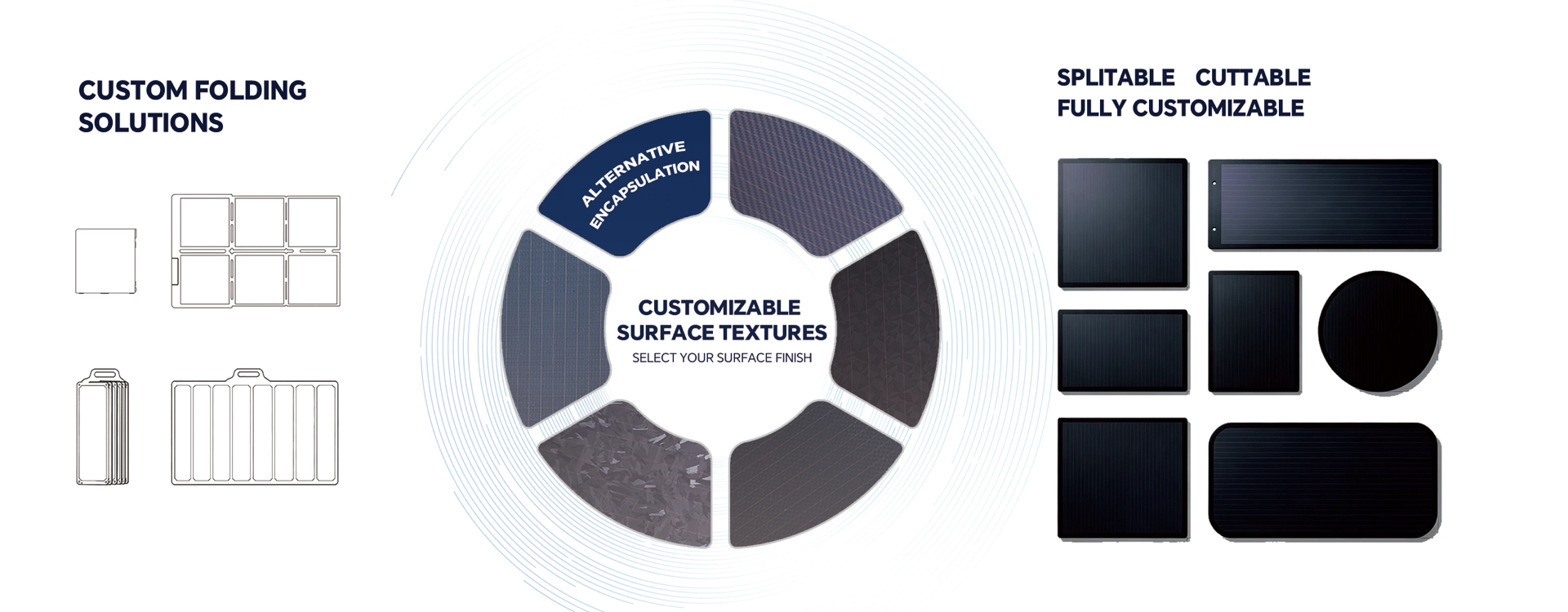
Parallel or cross fold, six surface textures, splittable and cuttable to any outline.
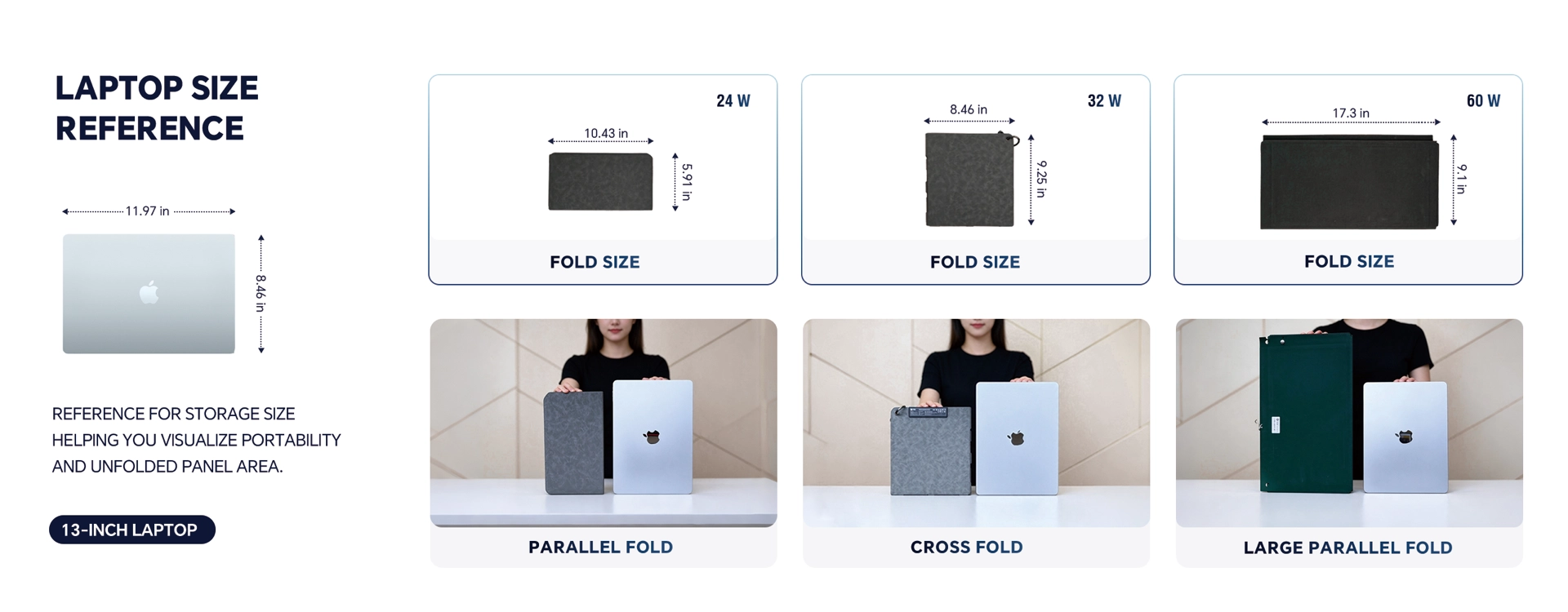
24W, 32W or 60W — every format packs down to a 13-inch footprint.
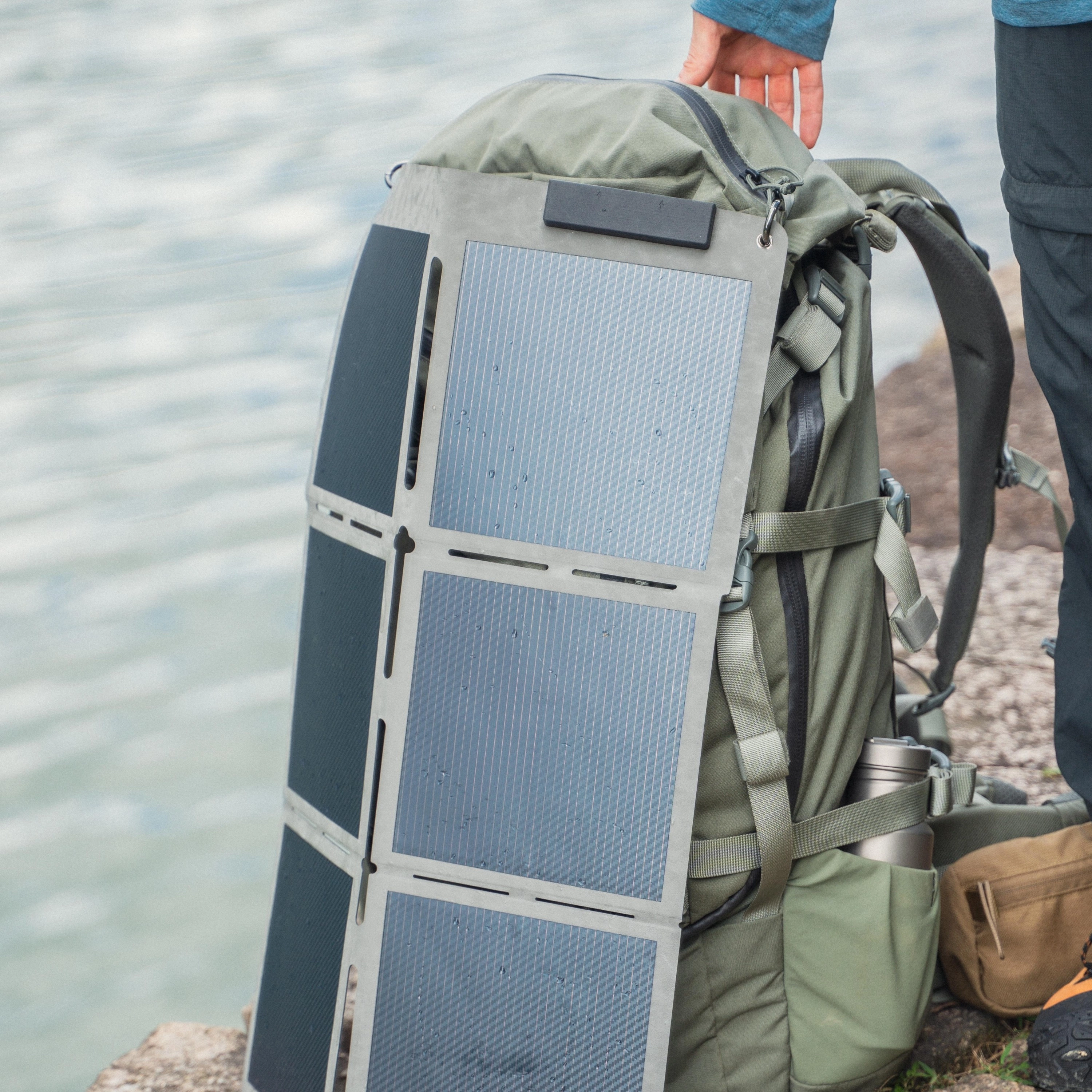
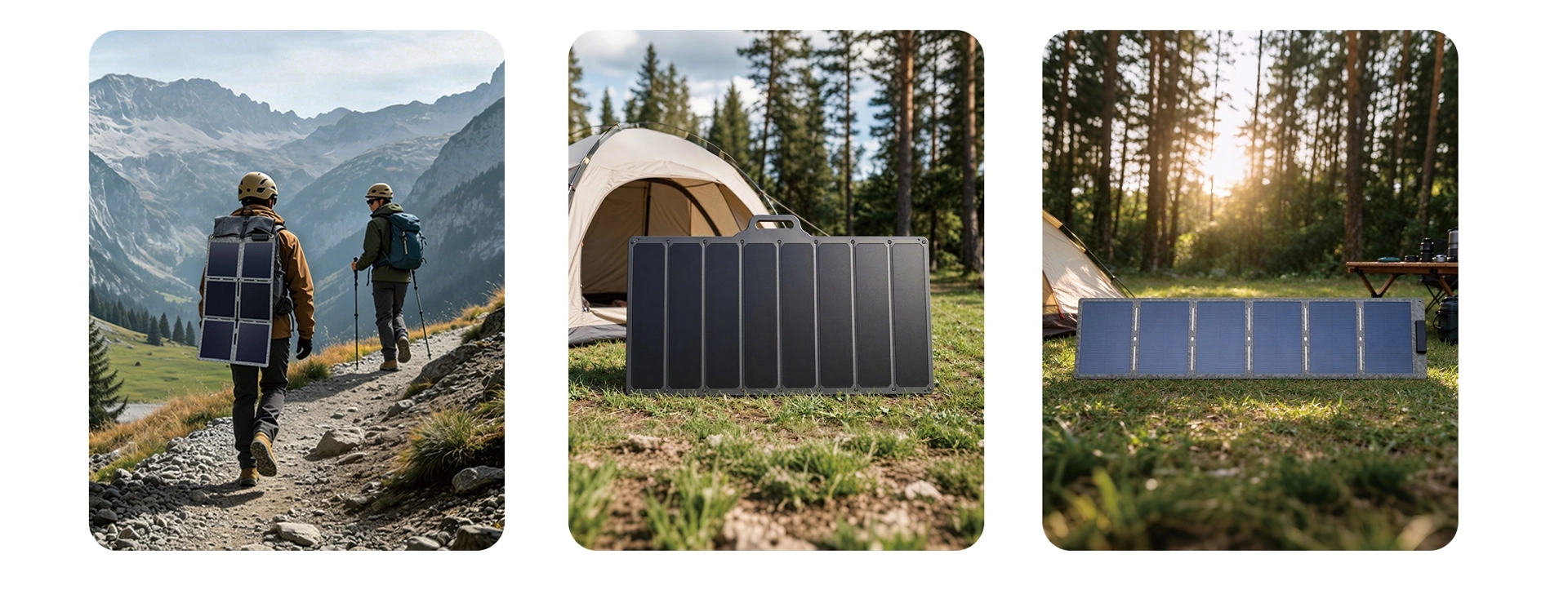
Strapped to a pack on the trail, propped at camp, laid flat to catch the light.
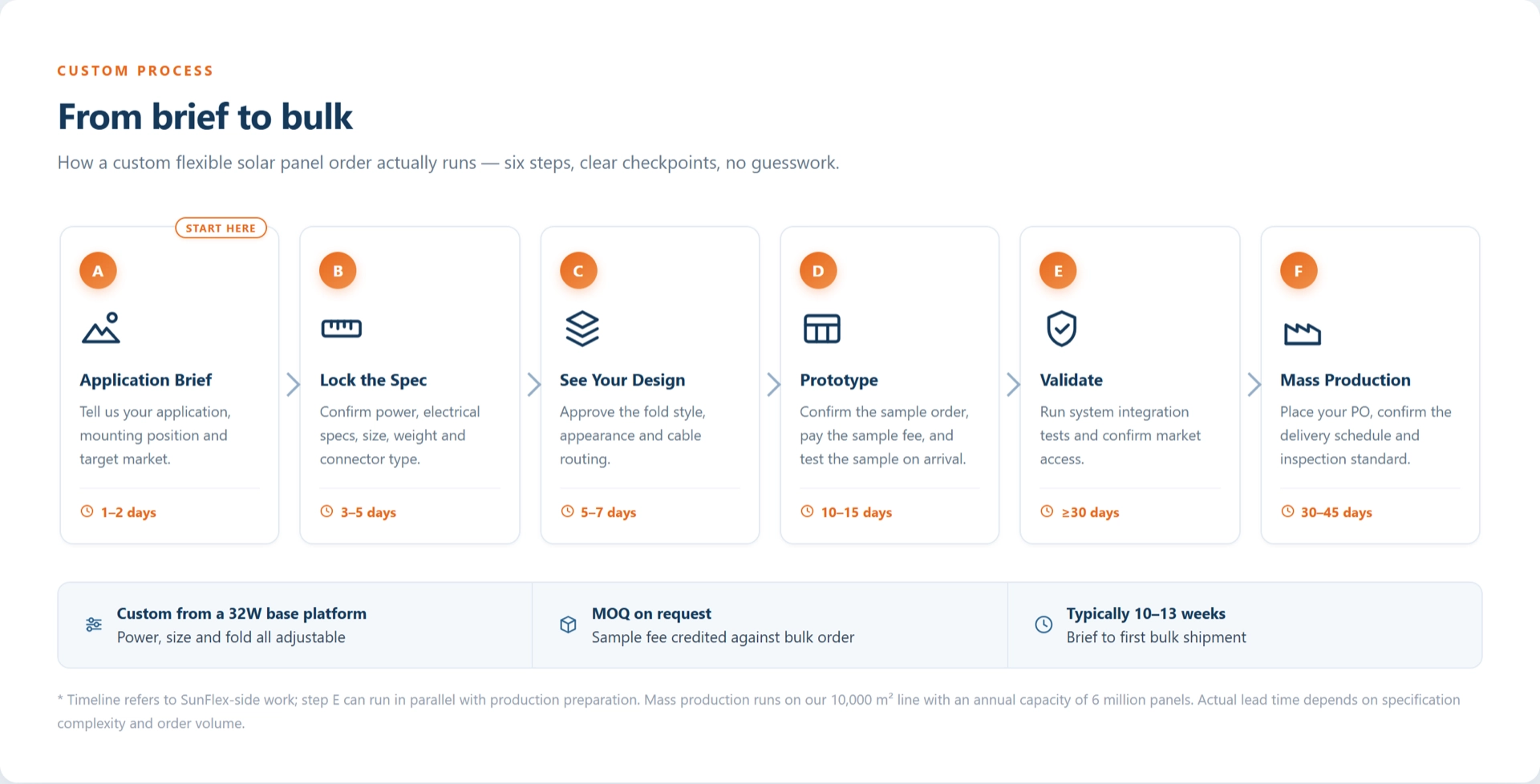
Spec locked in 5 days, prototype in 15, first shipment in 10–13 weeks.
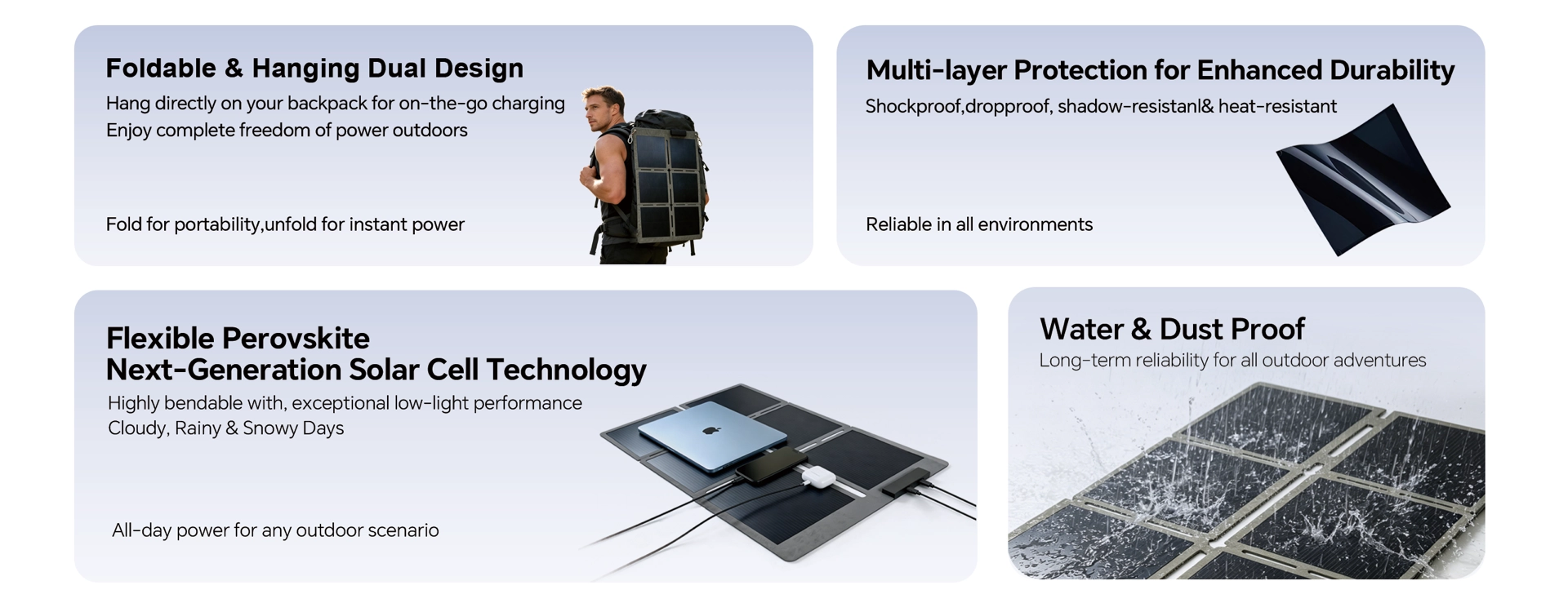
Fold-or-hang mounting, multi-layer armour, low-light perovskite, IP67 sealing.
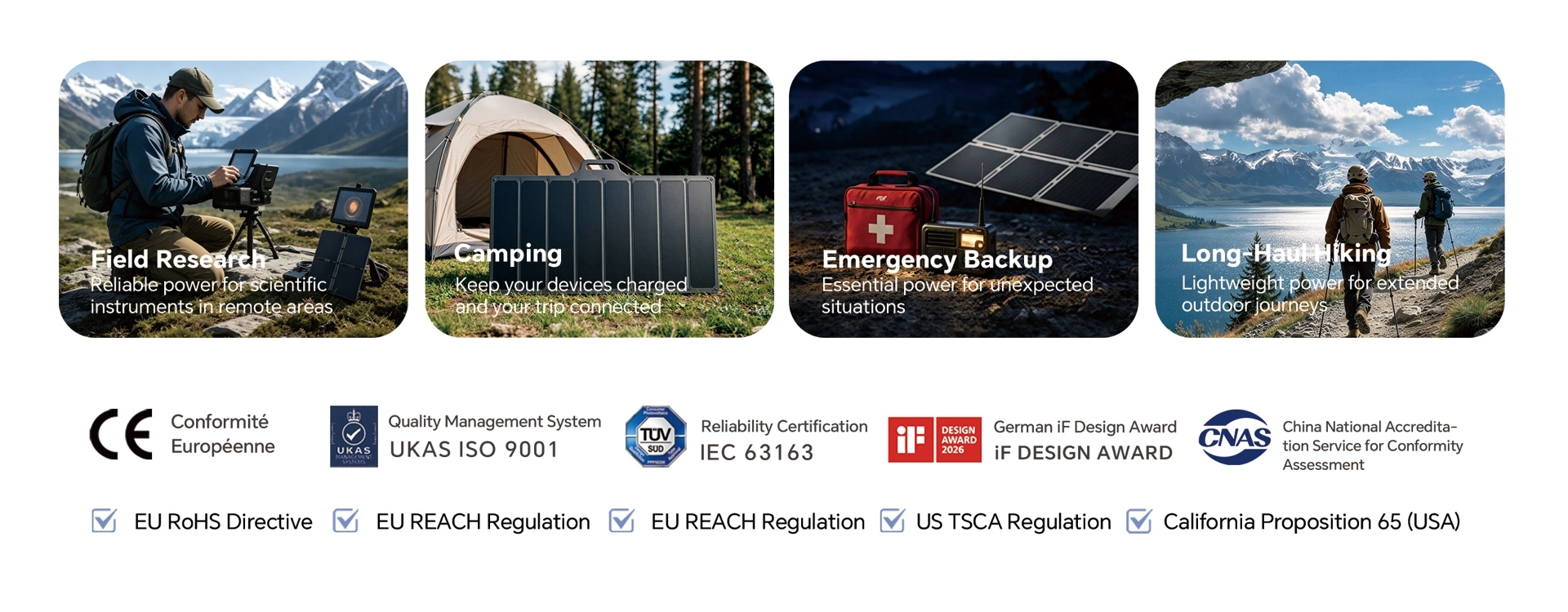
Field research to long-haul hiking — CE, TÜV SÜD, UKAS ISO 9001, iF 2026.
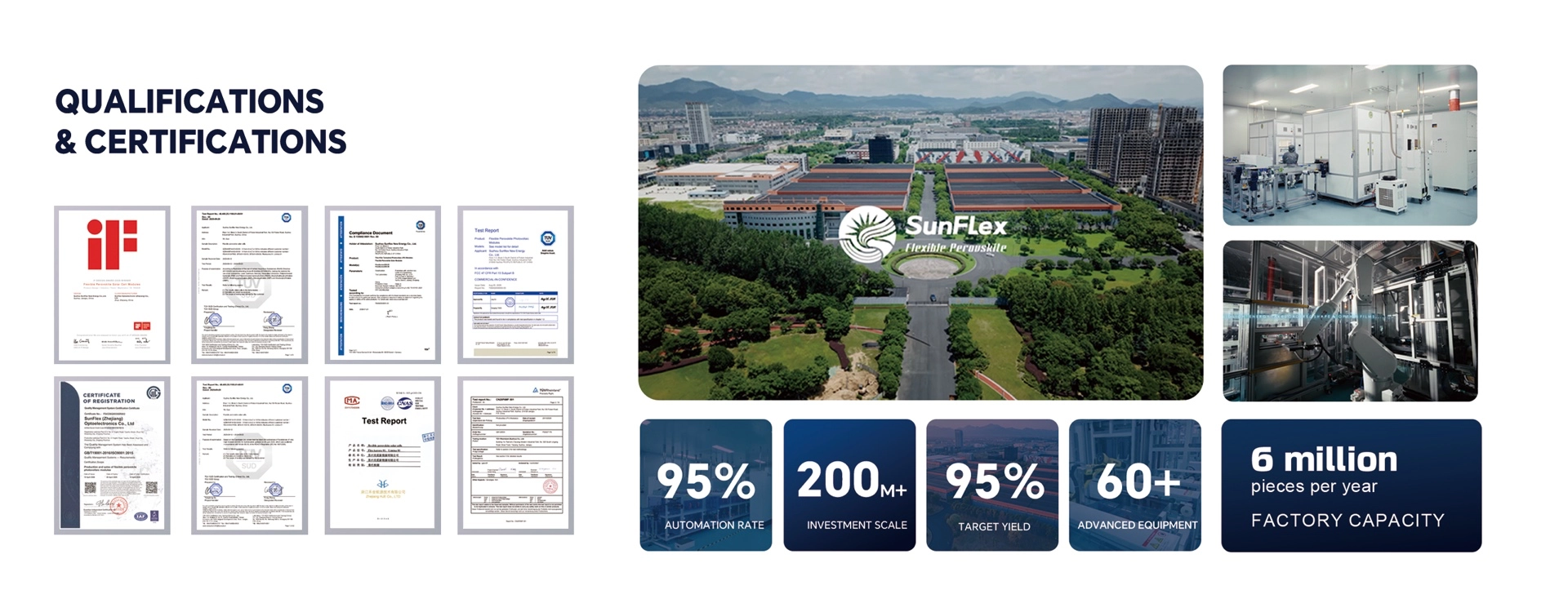
95% automation, a 10,000 m² line, 6 million panels a year in Suzhou.
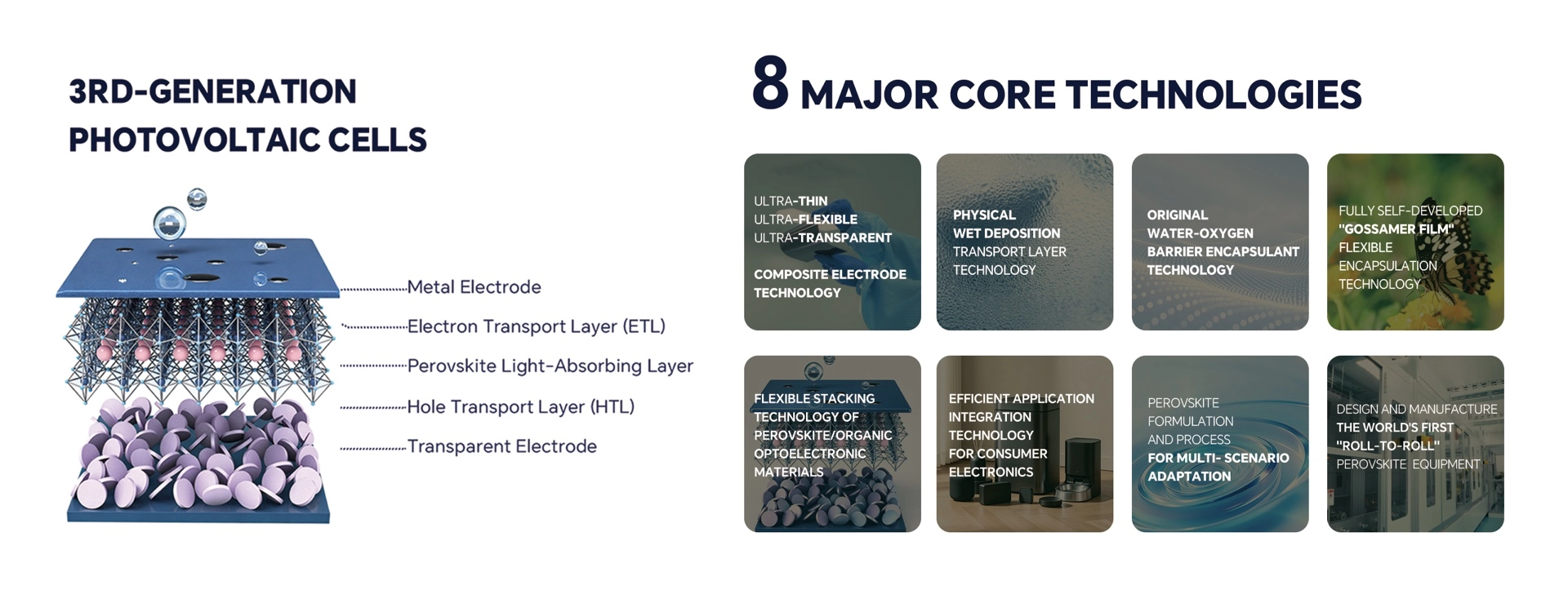
A perovskite stack that bends, stays thin, and keeps producing in low light.
Yes. Samples are provided based on each customer's project requirements. For custom (OEM/ODM) products, engineering drawings are typically delivered within 7 working days, and physical samples within 14 working days. Our technical team supports you throughout design-in, sampling and mass production, and all modules come with warranty coverage for manufacturing defects — specific warranty terms are provided with your quotation.
For optimal energy harvesting, the modules are designed to work with our proprietary MPPT (Maximum Power Point Tracking) controller, which maximizes power output under fluctuating indoor and low-light conditions. We provide full MPPT design and development support — from circuit design and debugging to integration validation — helping your engineering team move from evaluation to mass production smoothly. Output curves, dimensional drawings and reference designs are available on request to speed up your development.
Modules are certified to FCC, CE, RoHS, TÜV SÜD and ISO standards (CNAS / ilac-MRA accredited testing), and won the 2026 iF Product Design Award. Additional certifications for specific markets can be discussed for volume projects.
Multi-layer protection makes the modules weather-, bend- and impact-resistant. We offer both indoor-grade and outdoor-rated configurations with different encapsulation levels.
The modules are engineered for long-term stability with multi-layer encapsulation that shields the perovskite layer from moisture and oxygen. Certified by TÜV, they are rated for a service life of up to 10 years in indoor applications and 5 years in outdoor applications, maintaining stable power output with minimal degradation throughout the rated period.
Modules are 0.63–0.95 mm thin and weigh only 650–950 g/m², enabling integration into curved and space-constrained designs. They withstand a single bend radius above 150 mm and repeated bending above 200 mm. Note that they are bendable, not foldable — sharp creases should be avoided.
Absolutely — we offer full OEM/ODM customization. Modules can be cut and spliced to custom dimensions and power outputs, with three thickness grades (Standard Slim 0.95 mm, Premium Slim 0.80 mm, Ultra Slim 0.63 mm), plus custom packaging and branding. MOQ starts at 600 units with tiered pricing; contact us for volume quotes.
Yes. Perovskite is tuned for strong absorption across the visible light spectrum, giving it excellent low-light response and a low start-up voltage where conventional silicon cells barely produce power. Output remains stable at dawn, dusk, under shade and on cloudy days, with minimal degradation.
Output ranges from 12 μW/cm² at 100 Lux to 120 μW/cm² at 1,000 Lux (tested at 3000K, 25°C). Typical office and retail environments (300–500 Lux) deliver enough energy for low-duty-cycle smart devices. Output scales with module area, and our team can help size the right configuration for your product.
Indoors, they enable battery-free, maintenance-free power for IoT sensors, smart locks, video doorbells, security cameras, curtain motors, e-ink displays and consumer electronics under normal room lighting.
Outdoors, they provide trickle charging for wearables, bike lights, camping gear and other low-power devices — even in shade or cloudy light. Larger areas can be achieved by cutting and splicing modules to match your power budget.