

 en
 zh
 it
 es
 ja
 sv
 no
 nl
 ko
 fi
 ru
 fr
 de
 Oct 21, 2026

《Consensus statement for stability assessment and reporting for perovskite photovoltaics based on ISOS
procedures》
As the time comes to 2020, based on the previous ISOS testing methods for organic photovoltaic materials and devices, a consensus statement on stability assessment and reporting of perovskite photovoltaic devices was established. In this article, the original five test types are retained, and three new stress condition tests are added, namelyISOS-V (electrical bias stress), ISOS-LC (light and dark cycle test), ISOS-I (intrinsic performance test)。
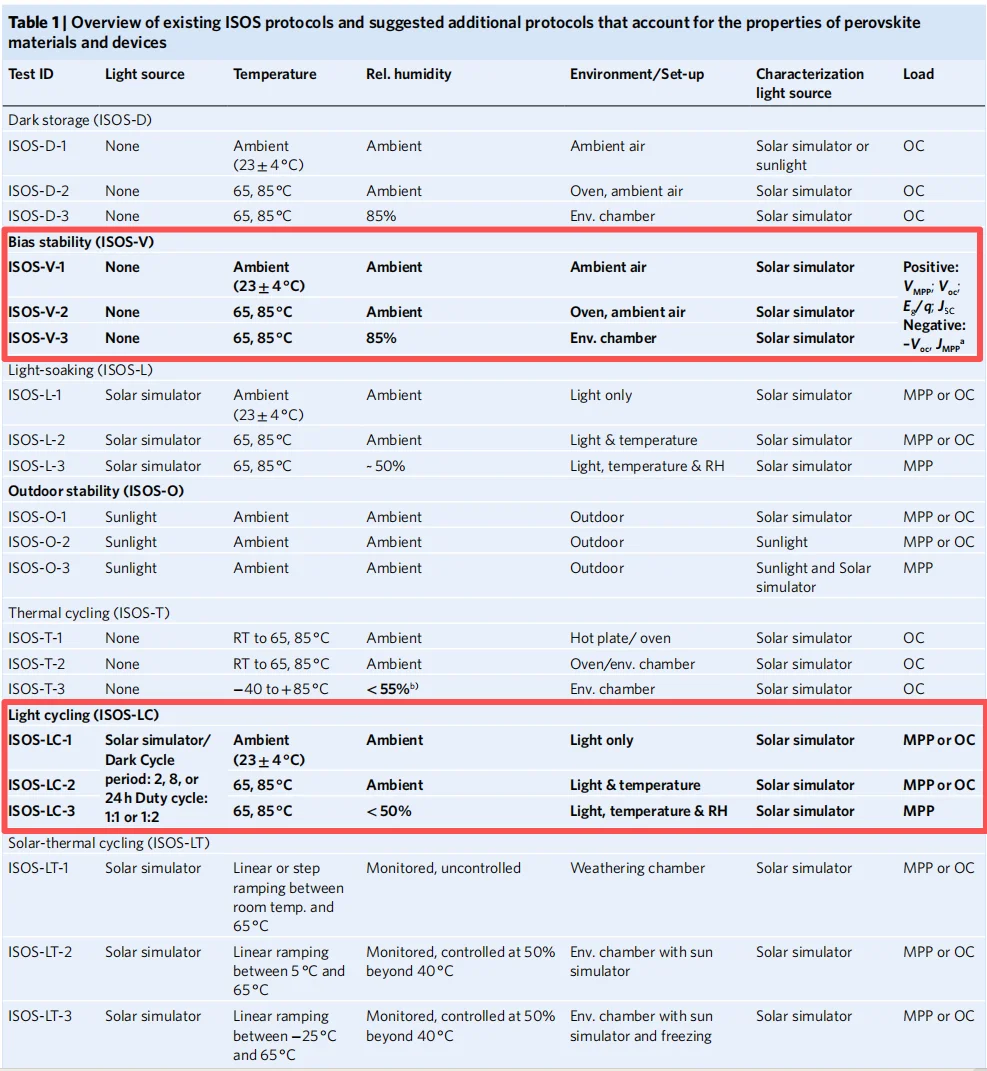
Figure 1. New ISOS test program
Electrical Bias Stress Test (ISOS-V)
The considerations for applying electrical bias stress mainly stem from the following points:
1. Usually the component is near the maximum power point state during actual operation (being forward biased), but after a sudden loss of light conditions, the battery will be in an open circuit voltage state. To this end, the article recommends,Apply a voltage equal to Vmpp or Voc as the forward electrical bias condition;
2. For shaded solar modules, the shaded cells can be forced to work by applying reverse bias to match the rest of the module. This is the reverse electrical bias condition. article suggestions,A constant negative bias can be applied, such as -Voc, is used to simulate the situation of components with bypass diodes being shielded, or forcing the current to reach -Jmpp is used to simulate the situation of components without bypass diodes being shielded.
In addition, as the level of test procedures increases, it is also necessary toSet the corresponding temperature and humidity.

Figure 2. Electrical bias test procedure parameters
Light and dark cycle test (ISOS-LC)
There are reports that perovskite cells can undergo complete or partially reversible degradation in a dark environment. Different stress conditions of light-dark cycles and steady-state photoaging (ISOS-L) will show different degradation modes.
In the previous article on organic photovoltaic materials and device testing, there are already tests related to light and dark alternation.ISOS-LT-2 and ISOS-LT-3, the method is to turn on the lighting during the humidity control stage (the part exceeding 40℃), and turn off the lighting during the stage when the humidity is not controlled.。
However, the single cycle time of this solution is short, and the temperature still exists as a variable during the stage when the illumination is kept constant. Therefore, it is not suitable for systematic research on the impact of illumination and its dynamic changes on device performance, and is more suitable for classification into the high-order thermal cycle test category.
To this end, the article revised a set of light and dark cycle test plans for perovskite batteries: in a cycle period of 2, 8 or 24 hours, the (light:dark) ratio is 1:1 or 1:2 for testing.
As the test level increases, additional stress conditions will be added.ISOS-LC-2A constant temperature condition was added to explore the effects of light and heat,ISOS-LC-3Constant temperature and humidity conditions were added to explore the effects of light, humidity, and heat.

Figure 3. Light and dark cycle test program parameters
Inherent Performance Test (ISOS-I)
Intrinsic performance testing aims to explore the performance of the perovskite cell and packaging materials themselves. The article divides the stress conditions that affect component performance into two major categories:
1、intrinsic factors(relevant no matter how packaged or protected the test environment is): light, temperature, electrical bias;
2、external factors(controlled by the interaction of the battery with environmental substances): water, oxygen.
The stability influence of external factors depends on the sensitivity of the battery to water and air as well as the stability of the packaging material.The packaging material serves as a barrier to protect the internal battery, and its barrier performance will directly affect the final performance of the module. Before fully understanding the degradation of the module, it is necessary to understand the stability and degradation mechanism of the packaging material.
The article suggests that the packaging material can be aged in the same aging procedure to test its barrier properties (water, oxygen) before and after aging. This approach is the same as the IEC 62788 series of tests.At present, no testing standards specifically for perovskite cell packaging materials have been established.It is expected to be improved in the future.
Regarding the research on the stability effects of internal factors, most of the test objects are packaged components. Since the barrier properties of the packaging materials are unknown after packaging (it is inconvenient to peel off and test), it is not conducive to distinguish the degree of impact of internal factors and external factors on battery stability.
therefore,Article suggestionsStore unencapsulated perovskite cells in inert gases (nitrogen, argon, etc.) for aging tests, other than that, the rest of the test conditions are the same as the procedures in ISOS. This type of test will be distinguished by adding "I" at the end of the test name. Figure 4 lists the procedures recommended for inherent performance testing in the protocol.
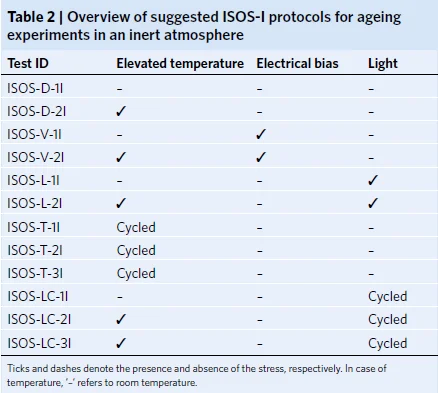
Figure 4. List of programs requiring inherent stability testing
《Transition of Perovskite Solar
Technologies to Being Flexible》
Compared with rigid perovskite components, flexible components are suitable for a variety of special application scenarios due to their flexible size and bendability.However, this characteristic also requires that flexible components must have good mechanical deformation capabilities, and their mechanical properties such as bending strength will directly affect the reliability and long-term stability of the device in practical applications.
The stability testing of perovskite cells in the existing ISOS protocol mainly focuses on studying the operating stability in light, heat, and moisture environments, while ignoring mechanical stability.The existing testing methods for flexible components mainly come from IEC 61215 (curling) and ICE 61646 (twisting).These methods can test the inherent bending resistance of flexible components, but due to the lack of additional stress conditions (such as temperature, humidity, electrical bias, light, etc.), the experimental results lack correspondence with actual applications.
Based on this background, LA Castriotta[3] et al. proposed four suggested test procedures for the bending properties of flexible perovskites, namely:ISOS-B (Bending Stability), ISOS-M (Mechanical Cycle), ISOS-TM (Dark State Thermal Bending), ISOS-LM (Light Moisture Thermal Bending).
Although these tests have not yet been formally incorporated into relevant international standards, they provide a feasible solution for testing the bending performance of flexible components, namely multi-stress comprehensive bending tests. I believe that in the near future, testing in this area will continue to be improved.
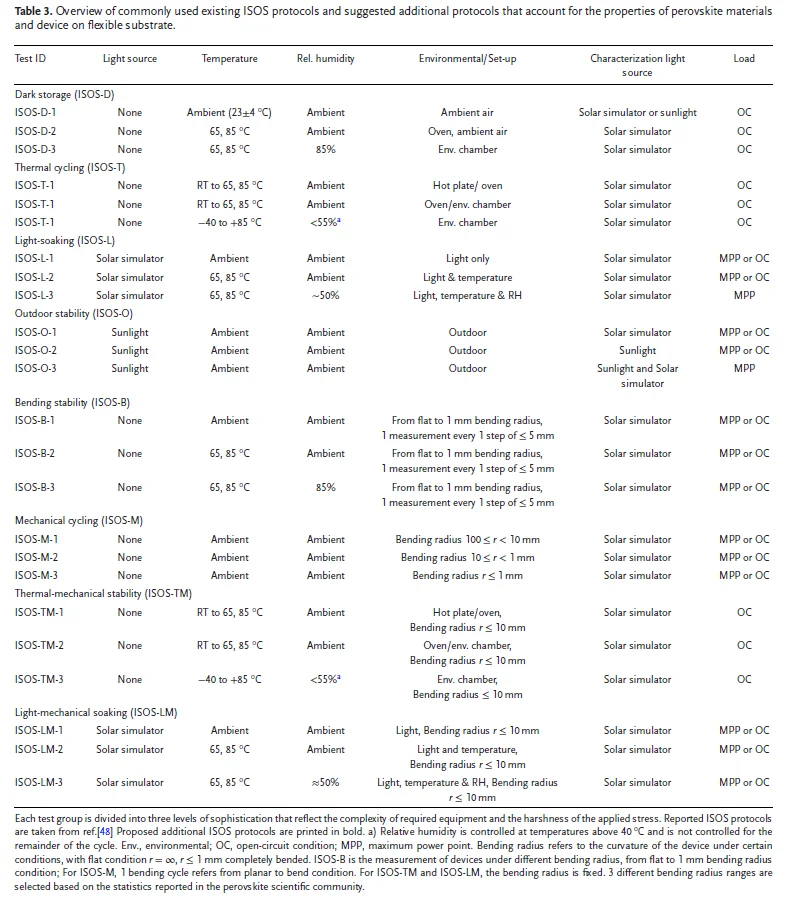
Figure 5. Test procedure recommended by LA Castriotta et al.
References
[1] Matthew O. Reese, Suren A.Gevorgyan et al. Consensus stability testing protocols for organic photovoltaic materials and devices. Solar Energy Materials and Solar Cells. Volume 95, Issue 5, May 2011, Pages 1253-1267. https://doi.org/10.1016/j.solmat.2011.01.036
[2] Khenkin, M.V., Katz, E.A., Abate, A. et al. Consensus statement for stability assessment and reporting for perovskite photovoltaics based on ISOS procedures. Nature Energy. volume 5. pages35–49 (2020), 35–49 (2020). https://doi.org/10.1038/s41560-019-0529-5
[3] Luigi Angelo Castriotta, Md Aslam Uddin et al. Transition of Perovskite Solar Technologies to Being Flexible. Advance materials. Volume 37, Issue 8, February 25, 2025
https://doi.org/10.1002/adma.202408036
The full text is over, thank you for watching
Copyright statement
The copyright of this article belongs to Shangrou New Energy
Welcome to forward to your circle of friends, please contact us for reprinting.
Recommended in the past